Fall 1981: Iolanthe
Notes
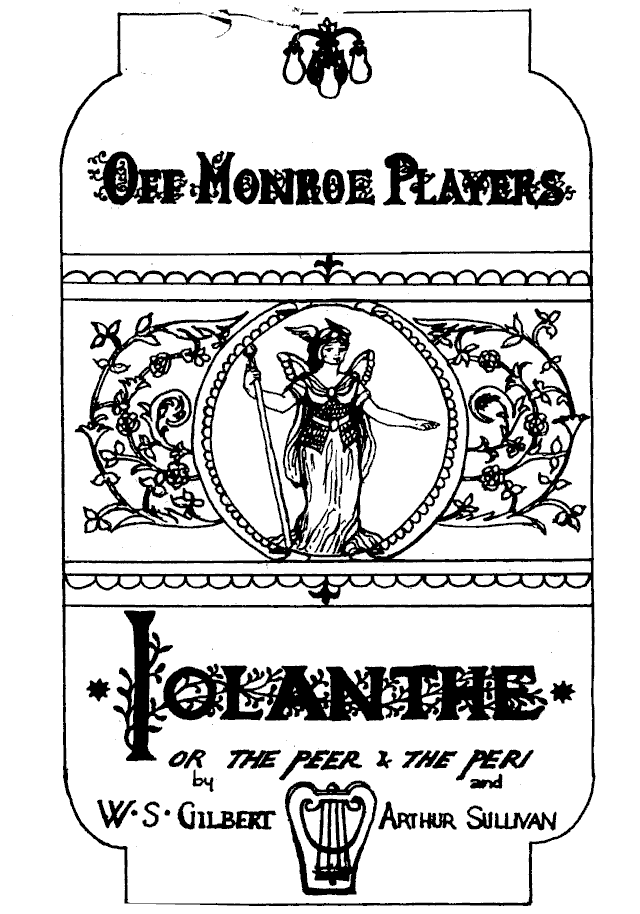
Our final performance of Iolanthe comes just three days before the 99th anniversary of its premiere at the Savoy Theatre on 25 November 1882. This "entirely original fairy opera" was the seventh collaboration between Gilbert and Sullivan and the first to open at the Savoy, which Richard D'Oyly Carte had built expressly to house the productions of the enormously successful partnership. The Savoy was the first theatre in the world to be lit by electricity, and electric light bulbs were consequently worked into the design of the original program of Iolanthe (this design is reproduced on the cover of our own program; the light bulbs may be seen near the top).
Gilbert had originally given out the title of the opera as Perola, largely to confuse the American "pirates" who had purloined versions of the previous Gilbert and Sullivan operas and paid no royalties to the authors when producing them. Only at the final rehearsal did Gilbert reveal the true title of the work, instructing the company to substitute "Iolanthe" everywhere that they had previously said or sung "Perola." One chorus member complained to Sullivan that she would not be able to remember the new name at the premiere, and the composer replied that she should use whatever name she like — the only person who might notice was Gilbert, who would not be in the audience anyway — his nervousness about first nights kept him pacing the streets of London until it was time for curtain calls.
As the Victorian era had seen an almost total transfer of power to a popularly elected House of Commons, the main target of Gilbert's satire in Iolanthe became the increasingly useless House of Peers, filled with well-born noblemen who would not have qualified if the criteria for admission were merit or intellectual distinction. The author also directs his fire at the legal profession (represented by the Lord Chancellor, the highest judge in all England) in which Gilbert himself had once been a less than successful participant. Sullivan, entranced by the fairy theme, turned for parody and inspiration to Mendelssohn's fairy music to A Midsummer Night's Dream and to Wagner's use of leitmotives (i.e. musical themes associated with particular characters) — indeed, the appearance of the Fairy Queen owes much to that of Wagner's Brunnhilde.
Of the thirteen surviving Gilbert and Sullivan operas, Iolanthe is one of only five for which Sullivan wrote and orchestrated the overture himself. Just an hour before conducting it at the premiere, though, Sullivan learned that his investment brokers had been ruined and his entire life saving had been wiped out. Still, as the new opera was about to begin a highly lucrative run of 398 performances, the composer did not remain a poor man for long. As one critic has said, "Seldom have fortunes been repaired so rapidly; but then, there were fairy wands at work on the Savoy stage that night."
Director: Alan Fischler
Music Directors: Terry Benedict, Esther Handleman Vail
Producer: Patricia Bonino Fischler
Cast
- Celia
- Rebecca Colvin
- Leila
- Karen Thomas
- Fleta
- Jill Herendeen
- Queen of the Fairies
- Esther Handleman Vail
- Iolanthe
- Valorie Powers
- Strephon
- Jeff Tomkinson
- Phyllis
- Maura M. Slon
- Earl Tolloller
- Corey Michels
- Earl of Mountararat
- Michael Bellavia
- The Lord Chancellor
- Robert Slon
- Trainbearer/Captain Shaw
- Bill DeMetsenaere
- Private Willis (of the Grenadier Guards)
- Alan Fischler
Chorus
Robert Baldwin, Maureen Barry, Terry Benedict, Amy Boyer, Mary Brzustowicz, Patricia Bonino Fischler, Carol Gayeski, T. Gaylord Herendeen, Malcolm Judd, Kim Rossetti, Julia Salter, Suzanne Schroeder, Lyn Shepard, Phil Sheppard, Brian Smith, Donna Smith, Philip Smith, Rob Ulliman, Martha Vail, Andrea Walter, Jonathan Wolfinger
Orchestra
- Flute
- Dolores Pfrengle
- Keyboard
- Valorie Powers, Carol Tennenbaum
- Percussion
- Dolores Pfrengle
- Trumpet
- Todd Elliott
Rehearsal Pianists: Carol Gayeski, Judy Hopkins, Valorie Powers, Brian Smith, Esther Handleman Vail
Crew
- House Managers
- Gail Hudak, Lois Palmer
- Props
- Lyn Shepard
- Set Designer
- Phil Sheppard
- Costume Manager
- Anne Havens
- Lighting Designer
- Bill Kachioff
- Program Design
- Anne Havens